
Fussy eating toddler help in Sydney and online
When every dinner feels like a battle
I'm a Certified Practicing Nutritionist and SOS-trained feeding therapist, and I offer fussy eating toddler help that looks at the eating and the body together.
5.0 from Google reviews

 Certified Practicing Nutritionist (AARPN)
 SOS-trained feeding therapist
 Private health rebates may apply
"Kelly has been amazing… she couldn't have come at a better time!"
Does this sound like your house?


They used to eat everything. Now it's five beige foods on repeat.


A new food on the plate means tears, or the whole plate gets pushed away.


The lunchbox comes home full, again.


You're quietly wondering: is this my fault? Are they getting enough?
You haven't done anything wrong, and there's usually a reason behind it. I'm a mum of two (one great eater, one who won't touch chicken), so I get it.
Why little ones get fussy
Having a picky eater toddler is really common. Toddlers are wired to be wary of new foods, and they're learning they can say no. Dinner is a popular place to practise. When it sticks around or gets worse, there's often something underneath.
That's why I look at both: what's happening at the table, and what's happening in the body.


Pressure at the table.
When we're anxious about every bite, kids feel it, and they often eat less.
Routines and grazing.
Lots of snacks or milk between meals can mean they're not hungry at dinner.
Sensory overwhelm.
Some kids find certain textures, smells or mixed foods genuinely hard.

Things in the body.
Constipation, low iron or a reaction to a food can all take the appetite away.

How I help: The Happy Table Approach for fussy eating
1Listen.
You tell me the whole story, from feeding as a baby to what dinner looks like now.
2Look underneath.
I look at things like constipation, low iron and sensory overwhelm, alongside the meal time routine.
3Lighten the table.
We start with family strategies: comfortable seating, less pressure, food play, and one family meal with a "safe" food on the table.
4Layer in support.
Food first. If your child needs more, we add targeted support, which might mean testing through your GP or feeding therapy.
5Keep going together.
Small steps, checked at two weeks, then monthly.
Google and AI tools can give you fussy eating tips. They can't watch how your child eats, spot the constipation or low iron underneath, or change the plan when week two goes sideways. That's what our appointments are for.
Initial consultation $220 · Private health rebates may apply
go on, dinner can waitFussy eating or something more?
For some kids, eating is harder than that. It's worth booking if your child:
- Eats a very short list of foods, and drops foods without adding new ones
- Gags, retches or vomits with new foods or textures
- Has stopped eating foods they used to eat, and hasn't gone back to them
- Gets very distressed at meal times, or you're all dreading them
- Has growth or weight that your doctor is keeping an eye on
Family strategies first, feeding therapy for kids who need more
Some children need more help than family strategies alone, including kids with ARFID (avoidant restrictive food intake disorder) and neurodivergent kids, such as autistic children or children with ADHD, who often experience food differently. For these families, feeding therapy alongside nutrition support can be a good fit.
I'm trained in the SOS Approach to Feeding, a play-based way of helping kids get comfortable with new foods at their own pace. I don't diagnose ARFID or any other condition, and I work alongside your GP, paediatrician, psychologist, OT or speech pathologist.

SOS feeding therapy in Sydney, coming in 2027
I'm opening one-on-one SOS feeding therapy sessions in 2027, for children who need more support than family strategies alone. Register your interest and you'll be first to hear when bookings open, including session details and prices.
Registering doesn't commit you to anything. If your child's NDIS plan is self-managed or plan-managed, you can use that funding with me.
Lunchboxes, day care and school
A full lunchbox at pick-up is one of the most common worries I hear. Kids eat differently away from home, where it's noisy, time is short and the playground is calling. Simpler food they can open and manage themselves often helps.
Read: Lunchbox ideas for fussy eaters →

What to expect
- 1
Before we meet
A short questionnaire about your child's health, eating and what you've already tried (yes, all of it).
- 2
First appointment
60 minutesWe go through the whole picture and you leave with first steps.
- 3
Your written plan
Within 2 business daysWith practical guides and recipes your family can use.
- 4
Follow-ups
40 minutesAt two weeks, then monthly. Most families have 4 to 5 appointments over about 3 months.
- 5
Working with your team
If your child sees a GP, paediatrician, OT or speech pathologist, I can keep them updated.
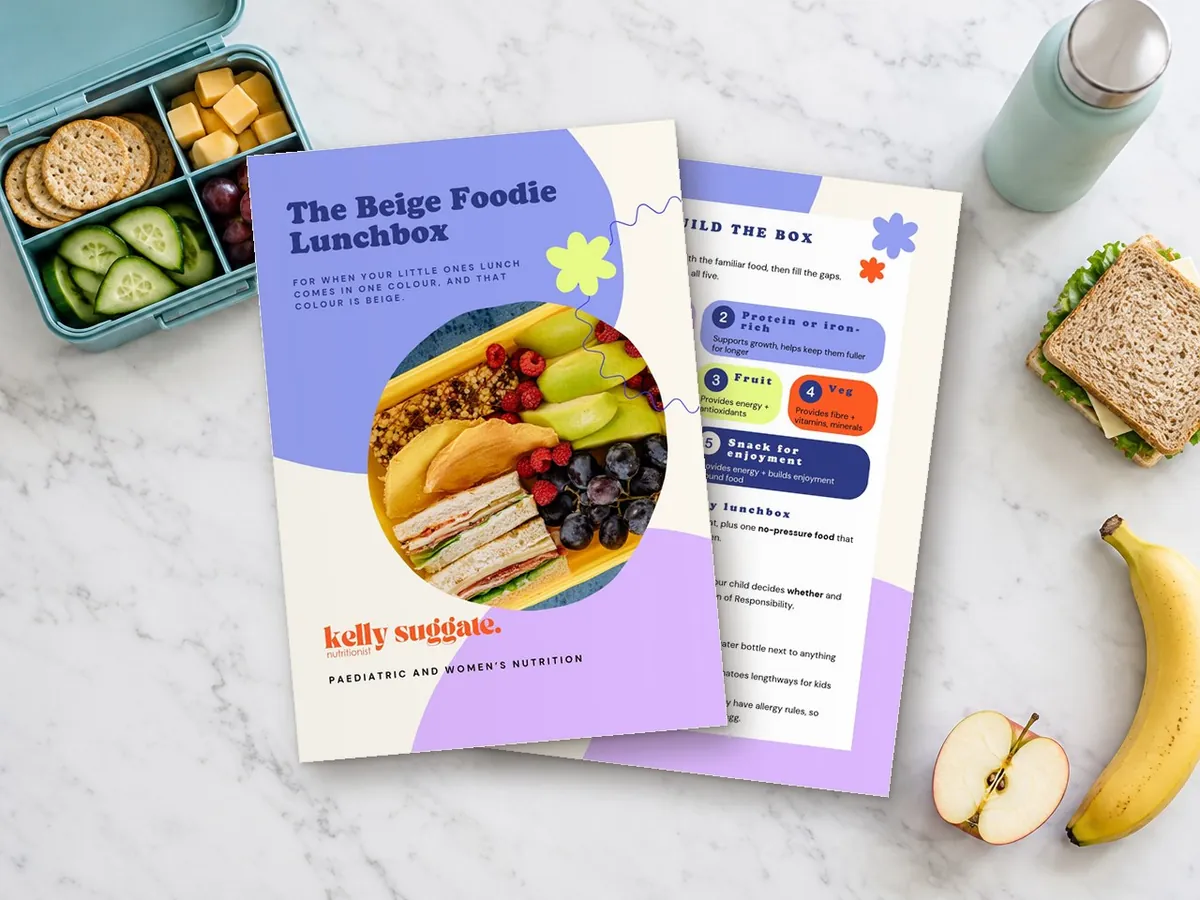
Free guide: The Beige Foodie Lunchbox
For when lunch comes in one colour, and that colour is beige. Build a balanced lunchbox, plus easy ways to add more fruit, veg and iron.
Questions parents ask, usually over a cold dinner
Why won't my toddler eat anything but snacks?
Snacks are easy, predictable and often always available, so they fill little tummies before meals. Spacing meals and snacks out and taking the pressure off at the table often helps. If it doesn't, I look at what else might be going on, like constipation or low iron.
Is fussy eating normal, or could it be ARFID?
Fussy eating is very common in toddlers and usually eases with low-pressure strategies. ARFID is different: the list of foods is very small, eating causes real distress, and it can affect growth or energy. I don't diagnose ARFID, but I can help you work out whether to talk to your doctor.
What is SOS feeding therapy?
SOS (Sequential Oral Sensory) is a play-based approach that helps kids get comfortable with food step by step: looking, touching, smelling and tasting, without pressure. I already use its principles in my appointments, and one-on-one SOS feeding therapy sessions open in 2027.
Should I cook a separate meal for my fussy eater?
Usually not. One family meal with a "safe" food your child already accepts on the table takes the pressure off you, and gives your child the chance to see, touch and maybe taste what everyone else is eating, without being made to. I'll help you set it up so it works in your house, even with a very short list of foods.
Do you work with autistic or neurodivergent kids?
Yes. Many neurodivergent kids, including autistic children and children with ADHD, experience textures, smells and changes in routine differently, which can make eating harder. I adapt the plan to your child's sensory needs and pace, and I work alongside their GP, paediatrician, OT, speech pathologist or psychologist. I don't diagnose autism, ADHD or ARFID.
Is feeding therapy covered by NDIS?
If your child's NDIS plan is self-managed or plan-managed, you can use that funding with me. For nutrition appointments, private health rebates may apply, depending on your fund and level of extras cover.
How long does it take to see a change?
Usually a few appointments, and small wins tend to come before big ones. A carrot that's allowed to stay on the plate counts. Every child is different, so I'll talk you through realistic expectations at your first appointment.
Let's make dinner calmer for everyone.
Initial consultation $220 · Private health rebates may apply
Online Australia-wide (Mondays and Fridays) or in person at Papaya Clinic, Newtown (Tuesdays and Thursdays) · Your written plan within 2 business days
 see you at the table